In our last article, we explained why every business with more than one owner should have a shareholders’ agreement.
Now comes the practical question.
What should actually be in it?
Every business is different. A technology start-up has different needs to a family farming business or a construction company. Even so, there are some provisions that appear in almost every well-drafted shareholder’s agreement.
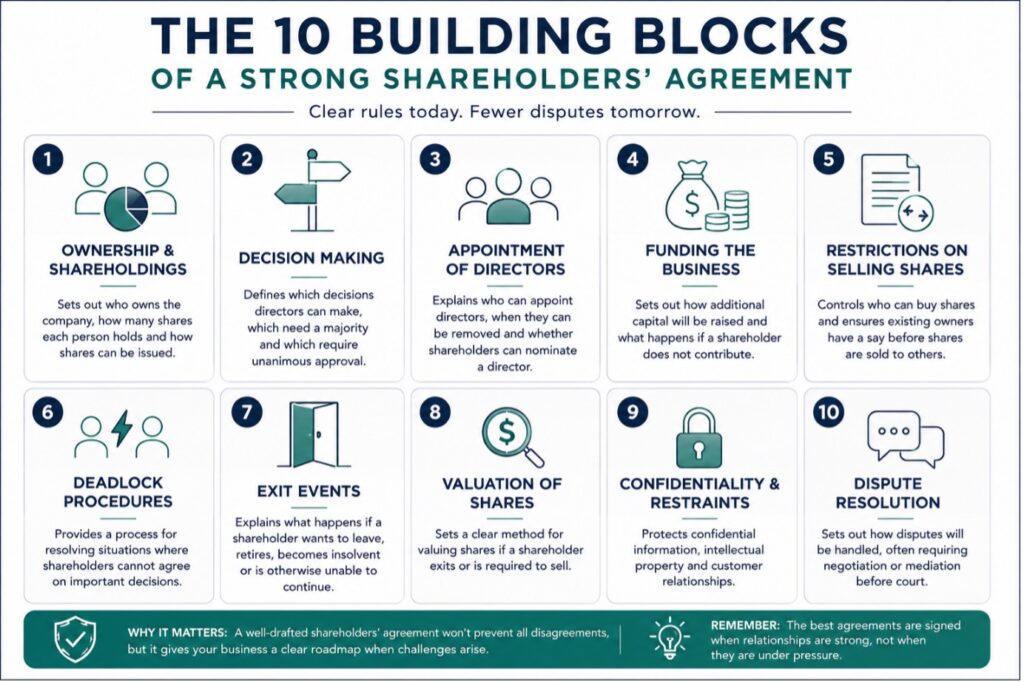
Here are ten of the most important.
1. Ownership and Shareholdings
Your agreement should clearly identify who owns the company and how many shares each person holds.
It should explain whether additional shares can be issued in the future and, if so, who has the power to approve them.
Without clear rules, ownership can change in ways that existing shareholders did not expect. One example of unexpected ownership might be if one of the shareholders passes away. Your shareholders agreement should
2. Decision Making
Not every decision should require every shareholder to agree.
The directors might decide which supplier to use or whether to employ another staff member. But should one shareholder be able to decide to sell the business, borrow millions of dollars or issue new shares without everyone else’s approval?
A good shareholders’ agreement identifies which decisions require unanimous agreement, which require a majority vote, and which can be left to the directors.
The goal is simple: everyone knows who has the authority to make important decisions before those decisions need to be made.
3. Appointment of Directors
Shareholders own the company. Directors run it.
In small business one person may wear both hats, but they are in fact very different roles with different rights and obligations.
Your agreement should explain who can appoint directors, when directors can be removed and whether particular shareholders have the right to nominate a director.
4. Funding the Business
Growing businesses often need more capital.
What happens if the company needs another $500,000?
Will shareholders be required to contribute additional funds?
What happens if one shareholder contributes and another does not?
A shareholders’ agreement should set out how future funding decisions will be made and the consequences if shareholders do not contribute as agreed.
5. Restrictions on Selling Shares
Imagine arriving at work on Monday morning only to discover your business partner has sold their shares to someone you have never met.
It sounds unlikely, but without appropriate restrictions, that may be possible.
Most shareholders’ agreements require a shareholder who wishes to sell their shares to first offer them to the existing shareholders. These are often called pre-emptive rights or a right of first refusal.
The purpose is straightforward. You should have some say in who becomes your future business partner.
6. Deadlock Procedures
Imagine you and your business partner each own 50% of the company.
You want to expand interstate.
Your partner wants to reduce debt and avoid further risk.
Neither of you is prepared to compromise.
The business stalls.
This is known as a deadlock.
A well-drafted shareholders’ agreement should include a clear process for resolving deadlocks before they threaten the business. That process might involve negotiation, mediation, expert determination or, in some cases, a structured buy-out mechanism.
7. Exit Events
Life changes. People retire, become ill, divorce or simply decide they want to do something different.
A good shareholders’ agreement explains what happens next. Can the departing shareholder keep their shares? Must they sell them? Who can buy them? When must payment be made?
8. Valuing the Shares
One of the most common sources of shareholder disputes is value.
One shareholder believes the business is worth $5 million.
The other believes it is worth $10 million.
Who’s right?
Rather than leaving the issue for future argument, a shareholders’ agreement should include a valuation mechanism. That might involve an independent valuer, an agreed valuation formula or another process agreed by the shareholders.
The important point is that everyone knows the process before they need it.
9. Confidentiality and Restraints
Shareholders often have access to confidential information, customer lists and trade secrets.
A shareholders’ agreement should explain what information must remain confidential and what restrictions apply if a shareholder leaves the business.
Those protections help safeguard one of the company’s most valuable assets: its information.
10. Dispute Resolution
Even the best agreements cannot prevent every disagreement.
A well-drafted shareholders’ agreement provides a roadmap before that happens.
Many agreements require the parties to negotiate or attend mediation before commencing court proceedings. Some also include expert determination for technical disputes.
Litigation should usually be the last resort, not the first response
The Bottom Line
Every business is different.
The best shareholders’ agreement is not the longest agreement or the one with the most clauses.
It is the one that considers the unique needs of your business and answers the difficult questions before they become expensive disputes.
Quick Quiz
How protected is your business?
Take two minutes and answer the following questions. If you answer “No” or “I’m not sure” to any of them, it may be worth reviewing your shareholders’ agreement.
| Question | Yes | No |
| Do you know exactly who can make major business decisions? | ☐ | ☐ |
| Can you stop a shareholder from selling their shares to someone outside the business? | ☐ | ☐ |
| Do you know what happens if a shareholder wants to retire or leave the business? | ☐ | ☐ |
| Is there a clear process if two shareholders cannot agree? | ☐ | ☐ |
| Do you know how a shareholder’s shares will be valued if they leave? | ☐ | ☐ |
| Does your agreement deal with the death or permanent incapacity of a shareholder? | ☐ | ☐ |
| Does it explain how additional funding will be raised if the business needs more capital? | ☐ | ☐ |
| Does it protect your confidential information, intellectual property and customer relationships? | ☐ | ☐ |
| Does it include a process for resolving disputes before going to court? | ☐ | ☐ |
| Has your business changed since your shareholders’ agreement was signed (for example, new shareholders, expansion, borrowing or investment)? | ☐ | ☐ |
What Your Answers Mean
Mostly “Yes”
That’s a good sign. Your business is likely to have a solid governance framework. Remember to review your Shareholders Agreement whenever your business changes or new risks emerge.
A mix of “Yes” and “No”
You have a foundation to build on, but there may be gaps that could become costly if circumstances change. A review now is usually far easier than resolving a dispute later.
Mostly “No”
Your business may be relying on assumptions rather than clear agreements. That can create uncertainty when shareholders disagree or circumstances change. A properly drafted shareholders’ agreement can help protect both the business and the people behind it.
If your agreement leaves you unsure how your business would respond to any of the questions above, it may be time for a review.
Need to speak with a lawyer?
Our experienced lawyers are here to help you understand your legal rights and options. Contact us for a confidential discussion about your situation.