
When people start a business together, they usually focus on the exciting things. They discuss the business idea, choose a company name, register the company and get to work.
Very few stop to ask an important question: What happens if things change?
What if one owner wants to leave? What if someone stops contributing? What if a shareholder dies? What if the business becomes successful and someone wants to sell?
These situations are more common than many business owners expect. A well-drafted shareholders’ agreement provides a roadmap for dealing with them before they become expensive disputes.
What is a shareholders’ agreement?
A shareholders’ agreement is a private contract between some or all of a company’s shareholders.
Its purpose is simple. It sets out the rules that the shareholders agree will govern their relationship, how important decisions will be made, and what happens if circumstances change.
Unlike a company constitution, a shareholders’ agreement is a private document. It is not usually lodged with the Australian Securities and Investments Commission (ASIC).
Isn’t the Corporations Act enough?
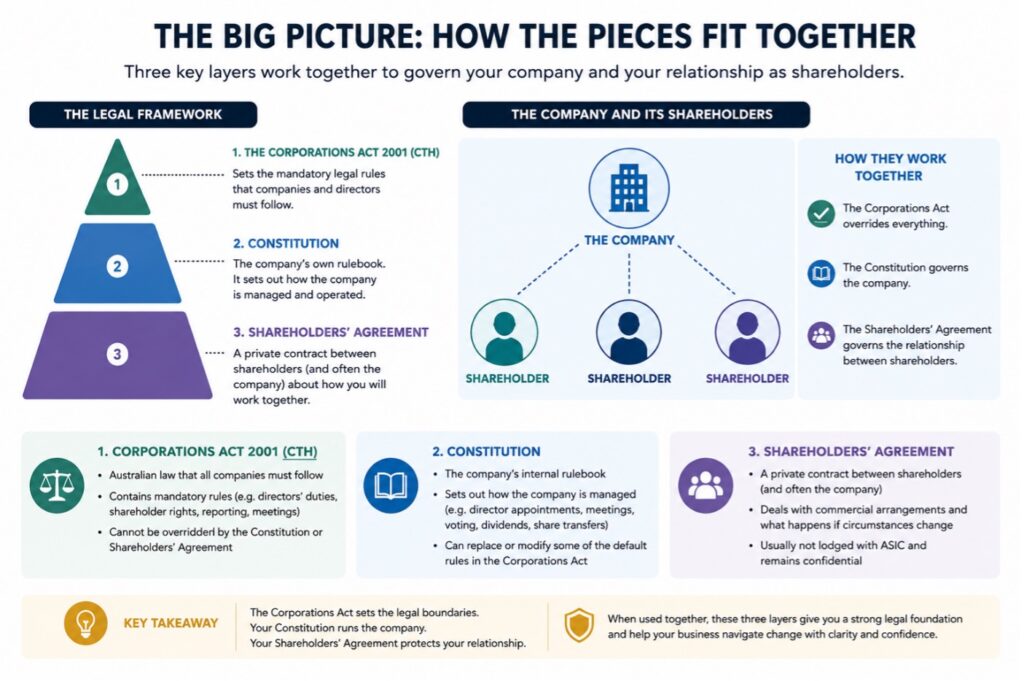
Australia does have comprehensive company laws. The Corporations Act 2001 (Cth) regulates directors, shareholders, meetings and many other aspects of corporate governance. It also provides a set of default governance rules, known as the “replaceable rules”, for many proprietary companies.
While those laws provide an important legal framework, they do not answer every commercial question that arises between business owners.
For example:
These are the types of issues that a shareholders’ agreement is designed to address.
How does a shareholders’ agreement fit with a company’s constitution?
Many business owners assume a company constitution and a shareholders’ agreement are the same thing. They are not.
A company constitution governs the company itself. It sets out many of the rules about how the company operates.
A shareholders’ agreement governs the relationship between the shareholders. It deals with the commercial arrangements between the owners of the business.
The two documents work together to serve two distinct purposes.
Why every business relationship changes
Most businesses begin with optimism. Friends go into business together. Family members invest together. Former colleagues become business partners.
At that stage, it can feel unnecessary, or even awkward, to discuss what happens if someone wants to leave or the relationship breaks down.
The reality is that businesses evolve. People retire. Families grow. Health changes. Sometimes people simply develop different ideas about the future of the business.
A shareholders’ agreement cannot prevent disagreements. It can, however, provide a clear process for resolving them.
A simple example
Imagine Sarah and Ben each own 50% of a small design business.
At the start, everything works well. Sarah manages clients and sales. Ben manages operations and staff. They trust each other, so they do not prepare a shareholders’ agreement.
Five years later, the business has grown. Sarah wants to expand and borrow money to open a second office. Ben wants to slow down and reduce risk. They cannot agree.
Then Ben decides he wants to retire and sell his shares to a friend. Sarah does not want to run the business with someone she has never met.
Without a shareholders’ agreement, Sarah and Ben may have no agreed process for resolving the deadlock, valuing Ben’s shares or controlling who can become a shareholder.
A well-drafted shareholders’ agreement could have answered those questions before the disagreement arose.
When should you put one in place?
The best time to negotiate a shareholders’ agreement is when everyone is on good terms.
At that stage, discussions are collaborative and reflect the parties’ intentions. The parties are more likely to agree on fair processes because they are planning for future possibilities rather than responding to an existing dispute.
Once relationships have broken down, negotiating an agreement becomes significantly more difficult.
Common misconceptions
“We trust each other.” Trust is important when building a business. But a shareholders’ agreement is not about distrust. It is about providing certainty if circumstances change in ways that nobody expected.
“We’re only a small business.” Many shareholder disputes occur in privately owned small businesses. In fact, closely held companies often rely more heavily on shareholders’ agreements because ownership and management are closely connected.
What does a shareholders’ agreement usually cover?
Every business is different, but many shareholders’ agreements address matters such as:
The content of each agreement should reflect the needs of the business and its individual shareholders.
The bottom line
A shareholders’ agreement is not a document you prepare because you expect your business relationship to fail.
It is a document you prepare because successful businesses plan for the unexpected.
The time to agree on the rules is before you need them.
In our next article, we’ll look at the ten clauses every Australian shareholders’ agreement should include, and why each one matters.
Need to speak with a lawyer?
Our experienced lawyers are here to help you understand your legal rights and options. Contact us for a confidential discussion about your situation.